Decoder packages
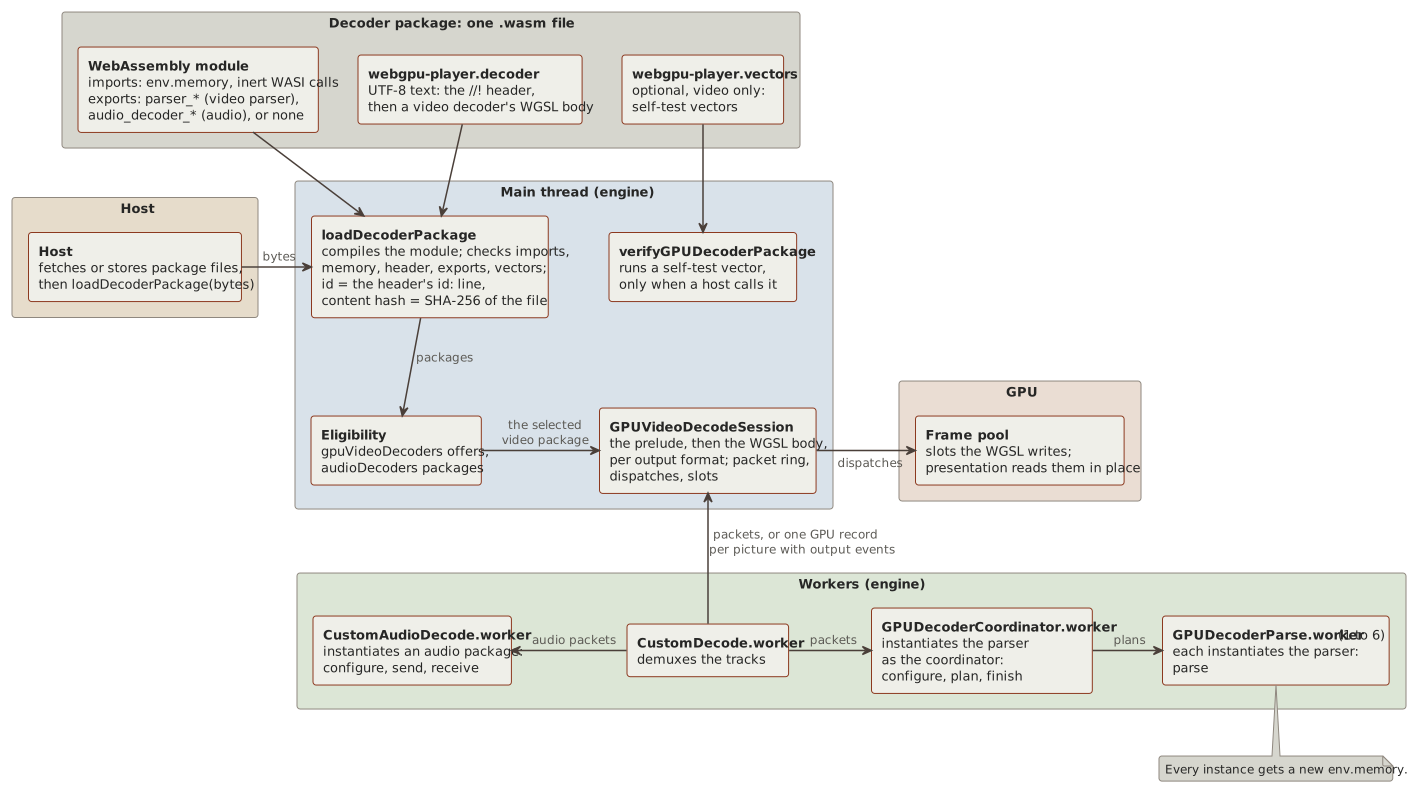
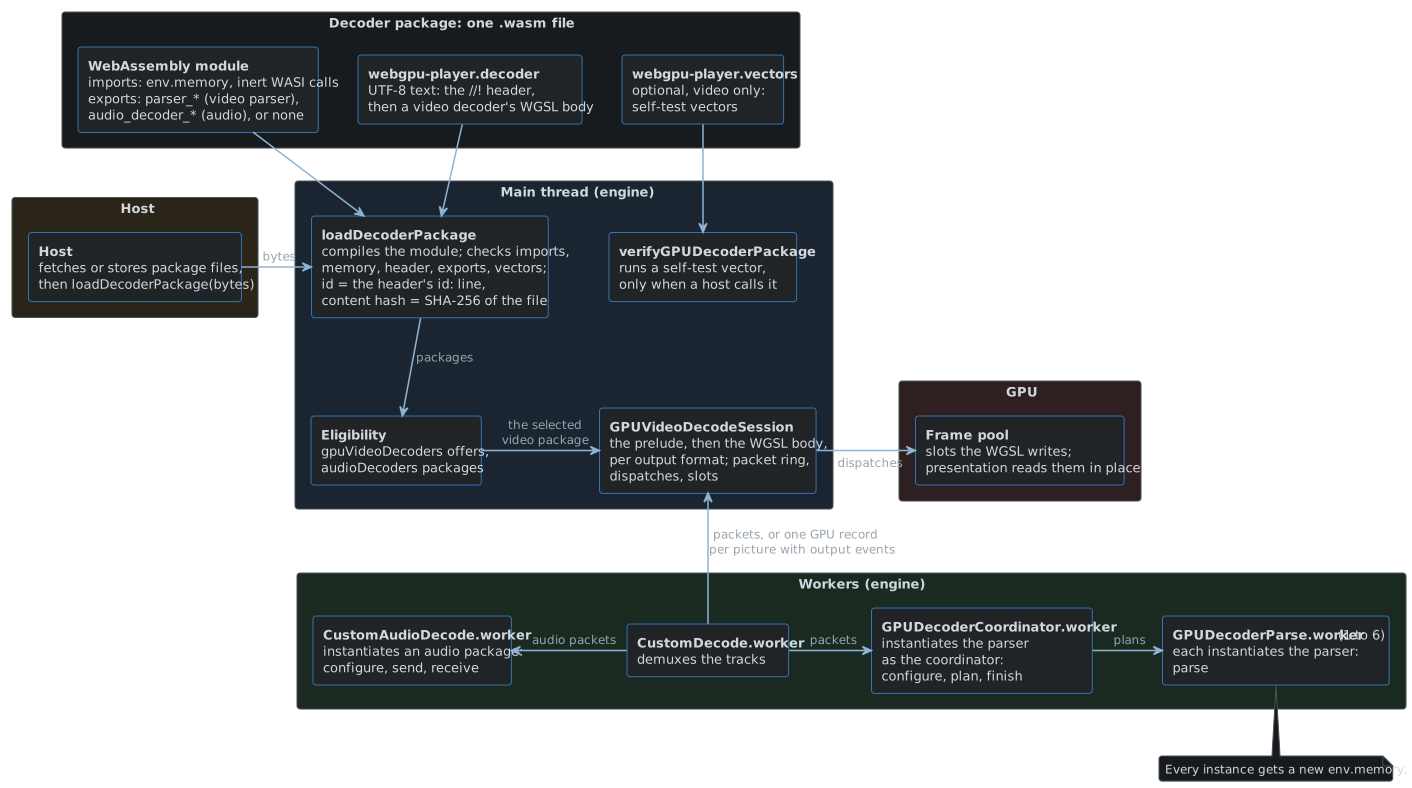
A decoder package is one .wasm file that adds a video or an audio decoder to the engine.
The engine has no decoder package of its own and names none: a host hands it the packages it loads, at runtime, and the engine reads what each one decodes from the package itself.
Packages are a fallback beside the browser’s decoders: a native WebCodecs route comes first, and a package plays only what the browser cannot.
A package carries no JavaScript, so a host may load packages from anyone.
The package file
A package is a WebAssembly module with custom sections; src/decode/packages/DecoderPackageFormat.json names them for the engine and its tools.
| Section | Holds |
|---|---|
webgpu-player.decoder | Required: UTF-8 text, a //! header and, for a video decoder, the WGSL body after it |
webgpu-player.vectors | Optional, video only: the package’s self-test vectors |
The header’s decoder: directive makes the package a video or an audio decoder.
A video package’s module is its parser, when its header declares parser:, or a module without code; an audio package’s module is the decoder.
Identity
A package’s id is the one its header’s id: directive declares, and every version of the package keeps it.
Its content hash, the lowercase hexadecimal SHA-256 of the whole file, tells its versions apart.
src/decode/packages/DecoderPackageIdentity.ts holds the rules.
- Every header, video or audio, declares
id:once. - An id is 1 to 64 characters: lowercase ASCII letters and digits, in runs joined by single hyphens, such as
av1,jpeg2000, orhevc-main-10. - A header without one fails as
directive-missing, a malformed one asid-syntax, and a longer one asid-length, so the package fails to load aspackage-manifest. - A host’s store keeps one file per id, so a new version replaces the old one.
- The engine keeps what it derives from a package, such as compiled pipelines and parse workers, by id with the content hash as the version, so a new version replaces what the old one left, and nothing counts or ages entries out.
loadDecoderPackage(bytes) in src/decode/packages/DecoderPackage.ts compiles the module and checks the package in this order.
It rejects with a DecoderPackageError whose message is the failed check’s code and a terse detail.
| Code | Check |
|---|---|
package-invalid | The bytes compile, and their binary reads |
package-section-missing | The decoder section exists |
package-section-repeated | No section appears twice |
package-encoding | The decoder section is UTF-8 |
package-import | The module imports only what packages may import, its memory once |
package-memory | The memory is imported, bounded, neither shared nor 64-bit, and not defined by the module |
package-kind | decoder: is video or audio |
package-manifest | The header parses, its id included; the detail carries the header’s own code, detail, and line |
package-export | The module exports every function of the interface its header declares |
package-vectors | The vectors section reads, and holds only formats the decoder writes; an audio package carries none |
Imports and memory
A package’s module may import only these:
env.memory, once: the memory the engine creates for each instance.env.emscripten_notify_memory_growth.- From
wasi_snapshot_preview1:args_get,args_sizes_get,clock_time_get,environ_get,environ_sizes_get,fd_close,fd_fdstat_get,fd_read,fd_seek,fd_write,proc_exit, andrandom_get.
The engine’s WASI calls are inert: arguments and the environment are empty, output goes nowhere, reads and seeks fail, the clock reads zero, randomness is zero bytes, and exit traps the call.
src/decode/packages/DecoderPackageImports.ts holds the whitelist and the stubs.
A parser and an audio decoder must import their memory as env.memory; a video package without a parser imports none.
Each instance gets a new memory with the module’s declared initial pages, which may not exceed 16384 pages (1 GiB).
Its maximum is the module’s declared maximum, or 16384 pages when the module declares none or more.
A module that exports _initialize, as a WASI reactor does, has it run before any other export.
Video decoders
A video decoder is WGSL: a //! header, then a body of compute entry points.
The engine compiles the body behind a prelude of its own for the output format a session decodes into, and runs the header’s dispatch sequence once per packet on the presenter’s device.
Decoded frames stay in a frame pool, one storage buffer of slots, which presentation reads in place.
The header
A header is the source’s leading lines that start with //!, one name: value directive per line; a bare //! line is skipped.
src/decode/video/gpu/GPUDecoderManifest.ts parses it, and a malformed header fails with a code, a detail, and the line.
| Directive | Required | Value |
|---|---|---|
id | Yes | The package’s id, as Identity describes |
name | Yes | Any text, which failures and hosts show |
decoder | Yes | video |
accepts | Yes | codec in [<codecs>], then optional conditions over stream.width, stream.height, stream.bitDepth, picture.width, and picture.height, separated by commas, which must all hold |
output | Yes | The formats it writes, one or more of I420, I420P10, I420P12, I422, I422P10, I422P12, I444, I444P10, and I444P12 |
monochrome | No | yes: it decodes a 4:0:0 stream into the 4:2:0 format of the stream’s depth, with the neutral value 1 << (bit depth - 1) in both chroma planes; eligibility offers a 4:0:0 stream to no decoder without it |
packet | Yes | The size of the largest packet it reads, at most 512 MiB for any stream, which sizes each session’s packet ring of two packets; an expression lets the bound grow with the stream, as AV1’s records do; the device’s buffer limit, the smaller of its largest buffer and its largest storage binding, must hold the ring |
dispatch | Yes, repeatable | <entry point>, <x>[, <y>[, <z>]] workgroup counts, or <entry point>, indirect <buffer> |
repeat | Repeatable | <count>, <dispatches>: the next <dispatches> dispatch directives run <count> times, or fewer for a picture whose parser reports fewer |
parser | No | 2: the module implements version 2 of the parser interface, and the decoder reads its pictures’ records instead of the container’s packets |
references | No | The pool slots it keeps as references, 0 to 16; 0 by default |
reorder | No | How many frames presentation order may trail decode order, 0 to 8; 0 by default |
state | No | The size of the persistent state buffer; empty by default |
buffer | Repeatable | <name>, <size>[, indirect]: a scratch buffer; indirect makes it usable for indirect dispatch |
requires | No | Device features it needs, such as shader-f16 or subgroups, which the prelude enables |
error | Repeatable | <code>, <name>[, <recovery>]: names an error code from 1 to 255, and how a playback recovers from it, conceal, drop, or resync, as Errors and recovery describes; a code without one ends the attempt |
The codecs in accepts are the engine’s codec names, which are FFmpeg’s: av1, h263, h264, hevc, jpeg2000, mpeg1video, mpeg2video, mpeg4, msmpeg4v1, msmpeg4v2, msmpeg4v3, vc1, vp8, vp9, and wmv3.
A size is a byte count with an optional B, KiB, or MiB, or an expression the session evaluates for each stream.
Sizes, workgroup counts, and repeat counts are expressions over these facts, in the presentation passes’ expression language: numbers, + - * / %, comparisons, && || !, and abs, ceil, floor, max, min, and round.
The accepts conditions read the stream and picture facts, and no output facts; the picture facts are theirs alone.
| Fact | Value |
|---|---|
stream.width, stream.height | The pool’s coded size: the picture size its session is sized for, rounded up to a multiple of 64, as How a session decodes describes |
picture.width, picture.height | In accepts only, the picture size a pool is judged for, before that rounding: the container’s visible size at eligibility, and the size a session’s pool is chosen for; a decoder bounds its pictures by them as its codec’s levels do, since the rounding can carry a legal picture’s pool past such a bound |
stream.bitDepth | The bit depth of the output format |
output.bitDepth | 8, 10, or 12 |
output.bytesPerSample | 1 or 2 |
output.chromaWidthDivisor, output.chromaHeightDivisor | 2 and 2 at 4:2:0, 2 and 1 at 4:2:2, 1 and 1 at 4:4:4 |
The dispatch sequence runs in order for every packet. A direct dispatch whose workgroup count is zero for the stream is skipped, and an indirect dispatch reads its counts from the named buffer, which an earlier entry point wrote. A repeat suits a wavefront, which dispatches once per wave: its entry points find their iteration in the decoder’s own state, and a count of zero skips the run. A parser may report a smaller count for each picture, such as the waves its picture needs, and the picture’s record runs the repeat that many times. A packet’s sequence holds at most 4096 dispatches once its repeats are expanded.
//! id: example-intra
//! name: Example intra decoder
//! decoder: video
//! accepts: codec in [jpeg2000], stream.width <= 4096, stream.height <= 4096, stream.bitDepth == 8
//! output: I420
//! packet: 8 MiB
//! state: 64 KiB
//! buffer: sliceCounts, 16, indirect
//! error: 1, sliceHeader
//! dispatch: parsePicture, 1
//! dispatch: decodeSlices, indirect sliceCounts
//! repeat: ceil(stream.height / 16), 1
//! dispatch: predictRow, ceil(stream.width / 16)
//! dispatch: reconstruct, ceil(stream.width / 16), ceil(stream.height / 16)

@compute @workgroup_size(1)
fn parsePicture() {
    // Reads the picture header with readPacketByte and writes the slice count into sliceCounts
}
The prelude
The engine compiles each output format’s module as its prelude followed by the decoder’s body, so one body serves every format it lists.
src/decode/video/gpu/GPUDecoderPrelude.ts generates the prelude, and compile messages map back to the body’s lines.
The body declares no bindings, no @group or @binding, and no enable directives, and its scratch buffers take none of the prelude’s names.
Each entry point compiles a module of its own, which src/decode/video/gpu/GPUDecoderEntryPointModules.ts makes of the whole one.
- A module holds the declarations its entry point reaches through the names they use, of the prelude and the body alike, with every directive and
const_assert; the rest is blank. - Every kept character stays at its line and column, so compile messages map back to the body as the whole module’s do.
- The split reads WGSL’s module scope: comments, which may nest, attributes, directives, and the
fn,struct,const,override,var,alias, andconst_assertdeclarations. - Code it does not understand, a name declared twice, or an entry point no function declares, compiles whole for every entry point.
- When an entry point’s module reports an error, the whole module compiles: its errors are the decoder’s, as before, and a whole module without errors serves every pipeline.
- A declaration no entry point reaches compiles nowhere, so its errors go unreported.
| Constant | Value |
|---|---|
OUTPUT_BIT_DEPTH | The format’s bit depth |
OUTPUT_CHROMA_FORMAT | 1 at 4:2:0, 2 at 4:2:2, 3 at 4:4:4, as chroma_format_idc counts them |
SAMPLE_BYTES | 1 or 2 |
SAMPLES_PER_WORD | 4 or 2 |
SAMPLE_MASK | 0xFF or 0xFFFF |
Every binding is in group 0.
| Binding | Name | Holds |
|---|---|---|
| 0 | packetBytes | The packet ring, read only |
| 1 | packet | The packet’s byteOffset, byteLength, index in decode order, keyframe, reset, and outputSlot |
| 2 | config | The codec private data from the container, read only |
| 3 | stream | The stream: three planes, each a byteOffset and bytesPerRow within a slot and a width and height; width, height, bitDepth, bytesPerSample, planeCount, slotByteLength, slotCount, and configByteLength |
| 4 | state | The persistent state buffer |
| 5 | framePool | The frame pool’s slots |
| 6 | status | What the engine reads back after each packet: the fatal error word and the header’s stream facts, then the packet’s block, its freed slots, its picture’s most severe recoverable error word, and its picture fields |
| 7 on | The buffer names | The scratch buffers, in declaration order |
Each buffer binds whole, and the device must hold each one within its buffer limit, so a decoder whose working set can pass a device’s largest storage binding spreads it over several buffer: lines, as AV1 spreads its frame store over two, and its WGSL picks the buffer by index.
A device holds at least eight storage buffers per stage, the prelude’s five among them, so a decoder may declare three storage scratch buffers on every device; more need a device that holds more, or the session fails as storage-buffer-count.
| Helper | Does |
|---|---|
readPacketByte(byteIndex), readPacketWord(wordIndex) | Read the current packet |
readConfigByte(byteIndex) | Reads the codec private data |
writeOutputSamples8(plane, x, y, samples: vec4u) | Writes four 8-bit samples of the output slot at a multiple of 4; one invocation owns each word |
writeOutputSamples16(plane, x, y, samples: vec2u) | Writes two 16-bit samples of the output slot at a multiple of 2 |
readOutputSample(plane, x, y) | Reads a sample an earlier dispatch wrote into the output slot |
readReferenceSample(slot, plane, x, y), readSlotSample(slot, plane, x, y) | Read a reference slot’s sample |
getSampleByteAddress(slot, plane, x, y) | The byte address of a sample in the pool |
releaseReferenceSlot(slot) | Hands a reference slot back to the engine |
reportDecodeError(word) | Reports an error word: a code the header gives a recovery marks the packet’s picture, which keeps its most severe word; any other ends the attempt, the highest such word winning |
reportHeaderFacts(width, height, bitDepth, visibleRectangle) | Reports stream facts parsed from a header, from one invocation |
reportPictureFields(interlaced, topFieldFirst, repeatFirstField) | Reports the packet’s frame’s fields, from one invocation: whether it is interlaced, which field comes first, and whether a progressive frame repeats its first field; a packet that reports none keeps what its container or parser gave |
An error word holds an error code the header names in its high byte and the failing value in its low 24 bits: (code << 24) | value.
A code without a recovery fails the session with decoder-error and the word, which the route describes by the code’s name and the value, such as sliceHeader: 12.
A code with one recovers, as Errors and recovery describes.
Codec private data
The config binding holds what the decode worker reads from the track for its codec, as FFmpeg’s demuxers hand it to their decoders; configByteLength is 0 when the track has none.
| Codec | config holds |
|---|---|
av1 | The track’s AV1CodecConfigurationRecord (av1C), its 4-byte header and then its configOBUs: a Matroska or WebM V_AV1 track’s CodecPrivate, or an ISO base media av1C box’s payload; nothing when the container has none, since temporal units carry their sequence headers |
hevc | The track’s HEVCDecoderConfigurationRecord (hvcC), or nothing for Annex B packets that carry their parameter sets, as in MPEG-TS |
mpeg1video, mpeg2video | A Matroska track’s CodecPrivate, its sequence header and extensions, or nothing |
vc1 | The sequence header and entry point FFmpeg’s vc1 decoder gets: a Matroska WVC1 or WMVA track’s extradata, or an ISO base media dvc1 box’s after its 7-byte VC1DecSpecStruc |
wmv3 | A 40-byte BITMAPINFOHEADER of the track’s coded size and the WMV3 FourCC, then the STRUCT_C sequence header, which holds no frame size of its own |
mpeg4, h263, msmpeg4v1, msmpeg4v2, msmpeg4v3 | A 40-byte BITMAPINFOHEADER of the track’s coded size and FourCC, then the track’s extradata, an MPEG-4 Part 2 track’s VOS and VOL headers, or nothing; a Matroska, MP4, or MOV track without a FourCC gets mp4v, s263, or MP43 by its codec, and FFmpeg’s MPEG-4 workarounds read the FourCC |
jpeg2000 | Nothing, for an MJ2 sample entry and a Matroska Video for Windows track alike |
How a session decodes
src/decode/video/gpu/GPUVideoDecodeSession.ts runs one decoder for one stream and output format.
- Each entry point’s pipeline compiles from its own module, as The prelude describes.
- The modules and their pipelines depend only on the package and the output format, so the device keeps each compiled decoder by package id and output format, with the package’s content hash as its version, in
src/decode/video/gpu/GPUDecoderPipelineCache.ts. A playback’s session of a kept decoder compiles nothing, sessions created at once share one compile, and a failed compile is not kept. A package’s new version replaces every decoder its old one compiled, while sessions of the old one keep their own pipelines; nothing else drops a decoder. A self-test vector’s check compiles a decoder of its own. - A session is created only once the worker has opened the file and described the track, and it waits for every pipeline of its decoder, since every packet dispatches every entry point.
GPUVideoDecodeSession.precompilecompiles a package’s decoder for an output format into that same cache before the stream is known, so a session created later compiles nothing and one created meanwhile joins the compile. A failed compile is left to the session, which fails the same way. Three calls insrc/presentation/PresentationSetup.tsstart it, earliest first:warmGPUVideoDecoders(presenter, videoPackages)compiles, in the background, the decoders later playbacks would take from packages the host already holds. Only codecs no browser decodes count, since no native route comes before their packages, and each such codec and output format takes the first package that writes it, in the host’s order. Each package format is onerunCustomDecodeBackgroundTask, so it waits behind the background probes, for an idle period, for no negotiation near, and for no playback; the warm-up ends at a dropped task or a device without a frame pool, and skips the rest of a package that fails to compile. Beyond the device’s own cache, it leaves the browser’s shader cache warm, so a later page’s session compiles in milliseconds.precompilePredictedGPUVideoDecoder(presenter, offers, options)compiles the decoderpredictGPUVideoDecoder(options, offers)insrc/capability/CustomPlaybackEligibility.tspredicts while the host still negotiates the playback. It predicts only a stream of a codec no browser decodes, in a container the engine plays that carries the codec, with an SDR color and a scan and rotation a route presents, and takes the first offer that decodes and fits it, as eligibility would;predictGPUVideoDecodeTarget(options)gives its codec and format first, so a host loads only the packages that match. The audio and the presentation are not judged, so a playback they refuse has compiled a decoder it never uses.precompileGPUVideoDecoder(presenter, eligibility)compiles only the frame-pool route’s chosen decoder, as soon as the host has the eligibility.
- Sizes and counts evaluate once per session, from the stream facts; nothing evaluates per packet, and a picture’s own repeat counts only lower a repeat’s count.
- A first session’s stream facts come from the container’s size, or from the larger of it and the largest picture the parser read in the codec private data, such as an AV1 sequence header’s maximum frame size, when the decoder’s
acceptstakes that picture size and the device holds its pool, state, scratch buffers, and packet ring; a stream whose frames grow past the container’s size, as AV1 resolution changes do, then fits the pool.selectGPUDecodeSessionStreaminsrc/decode/video/gpu/GPUDecoderStreamFit.tsdecides, and eligibility checks the container’s size the same way, so a stream never becomes ineligible for its declared maximum. - The pool holds the decoder’s
references, itsreorderdepth, three slots for presentation, and two spares when the decoder keeps references. - Each packet goes into a ring of two packets at a word-aligned offset, and its
packetuniform names the slot it decodes into. With a parser, each of the session’s packets is one picture’s record, with its packet’s timestamp, duration, and keyframe flag. - The first packet after a start or a seek carries
reset; the engine clears the state and status buffers before it, and the decoder drops what it held. - A decoder without references frees a slot when presentation releases it.
A decoder with references holds every output slot until it calls
releaseReferenceSlot; the engine reads the freed slots back a few frames behind, which the spare slots cover. - Without a parser, frames present in timestamp order once
reorderframes wait; a frame earlier than one already presented is dropped, asframes-dropped. - With a parser, its output events present or drop each frame, as the next section describes.
- A frame presents its visible rectangle scaled into the stream’s display area: the visible size its picture reported, at the slot’s top left, or the stream’s visible rectangle.
- Every packet’s status reads back asynchronously, and the packet’s frame presents only once it has, as the next section describes.
- A picture the session cannot hold, of another output format or beyond its pool, goes to a session of its own, as Stream changes describes.
Errors and recovery
A damaged packet need not end a playback: a decoder that can go on past an error says how in its error: lines, and the engine counts each recovery.
| Recovery | The packet’s frame | Then |
|---|---|---|
conceal | Presents: the decoder concealed the damage, as FFmpeg’s error resilience conceals damaged macroblocks | Decoding goes on |
drop | Never presents | Decoding goes on from the decoder’s state |
resync | Never presents, nor does any later frame before the next key packet; the last good frame repeats in their place | The next key packet decodes from a reset |
| None | Never presents | The attempt ends with decoder-error |
- The session submits a packet only when a status readback buffer is free for it, and copies the status into it after the packet’s dispatches.
- The fatal error word and the header’s stream facts last until a reset clears the status; the packet’s block, its freed slots, its picture’s error word, and its picture fields, holds one packet’s reports, and the engine clears it after each copy.
- A frame presents only once its packet’s readback applied, so a recovery always applies before its frame could present.
reportDecodeErrorkeeps the packet’s most severe recoverable word:resyncoverdropoverconceal, then the highest word.- A resync replaces each frame of the damaged packet, and of the packets after it that already decoded, with a repeat of the last good frame: of the earlier packets’ frames that the session or presentation still holds, the one with the latest timestamp.
Each packet up to the next key packet repeats it too, at its own time, without running the decoder.
The repeats share that frame’s slot, on which the pool counts holds; without a good frame they drop.
The decoder’s references end with the old epoch, and the key packet decodes with
reset. - With a parser, the session numbers repeated pictures as it numbers decoded ones, so the parser’s events keep naming them; an event for a repeated picture changes nothing.
- A parser call that fails with a code its header gives any recovery resyncs, since the failed call made no picture and left its instance unusable.
The decode worker closes the parser, posts the failed packet and those before the next key packet as held packets, which carry no data and repeat the last good frame, and opens a new parser at the key packet, whose first picture carries
reset. The session presents the frames the old parser left undecided in timestamp order, since no event will decide them. Without a later key packet, the packets up to the track’s end hold, and the track ends. A failed call whose code has no recovery, or a failed check of the interface, ends the attempt. - A recovery’s detail is the error’s name and value,
parserbefore a parser’s error name, such ascoefficients: 90112orparser sliceHeader: 3. The feed’s telemetry counts recoveries since the page loaded asrecoveries, one entry per code,concealed,dropped, orresynced, and error name, with the latest detail. - A self-test vector that recovers fails its check as
decoder-recovered, since a vector is undamaged. - Without a recovery for its codes, a decoder ends the attempt on every error, as before recoveries existed; the route then falls back as any failed route does.
Stream changes
A stream may change midway in a way its session cannot follow, as an AV1 sequence header that raises the maximum frame size or changes the bit depth or chroma subsampling does, or an MPEG-2 sequence header of a larger size, as a broadcast stream that switches resolution has.
GPUVideoDecodeFeed in src/decode/video/gpu/GPUVideoDecodeFeed.ts checks each picture the parser reports against the request its current session was made for and that session’s pool, in getGPUVideoDecodeStreamChange.
- A picture needs a new session when it reports another output format, or a requirement its pool does not hold: the larger of its sequence’s largest picture and its own visible size on each axis, against the coded size of the pool its pictures decode into.
- The new session decodes only the new sequence’s pictures, so its pool takes the requirement alone, rounded up to 64, even below the pool before it, when the decoder’s
acceptstakes the requirement and the device holds the pool and the decoder’s buffers. - Otherwise the pool takes the fallback, the pool before it grown to the picture’s own visible size, as for a declared maximum far beyond the frames, such as 16384x8704 for frames of 640x360.
- A picture its pool holds starts no session when its requirement is the maximum its session asked for already, or one the decoder’s
acceptsrefuses, since its pool would be the fallback, the current one. - The new session’s request keeps the decoder and the codec private data, and takes the picture’s format, the requirement as its maximum, and the fallback;
chooseGPUDecodeSessionStreaminsrc/decode/video/gpu/GPUDecoderStreamFit.tschooses its pool. - The feed creates it while the current session decodes on; the picture and every packet after it wait for it.
- Pictures queued while a session is created, the first one or a change’s, wait unjudged, and are judged against its pool once it exists, since the device may give it a smaller pool than its request asks for.
- The current session hears that its packets are complete, with the picture’s events that name earlier pictures, and presents its last frames.
- Once the current session decoded its packets and its decode work completed, the new session takes over, numbering its pictures on from the picture’s index so the parser’s events keep naming them, and its first packet clears its state.
- A replaced session stays until presentation releases its last frame, and is destroyed then.
- Presentation reads each frame’s sample size, bit depth, and chroma subsampling from its slot’s layout, and binds each pool as its frames arrive, so frames of every output format and pool present through one chain.
- A change can come only where the decoder needs no earlier picture, since the new session holds no references of the old one: at an AV1 key frame after a new sequence header, or at an MPEG-2 sequence header of a larger size or another chroma format, after which FFmpeg drops every reference too.
- A seek configures the session from the track again, and a picture after it that the session cannot hold changes the session again.
- A change whose requirement and fallback the decoder’s
acceptsboth refuse fails the attempt asaccepts: picture 4096x2160 in pool 4096x2176 at 8 bits, the fallback’s picture size, pool, and bit depth. - A new session that cannot be made fails the attempt with its creation failure, such as
format-unsupported: I444P12 not in I420, I420P10for a format the decoder’soutputlacks.
The parser interface
A parser is the package’s module: CPU code that turns each packet into what the WGSL reads, such as a picture’s parsed syntax, where entropy decoding is serial.
It implements version 2 of this interface, and its header declares parser: 2.
A packet may hold several pictures, such as an AV1 temporal unit’s hidden frames beside its shown one, and each picture has its own plan, parse jobs, finish, GPU record, output events, visible size, and repeat counts.
src/decode/video/gpu/GPUDecoderParser.ts drives it.
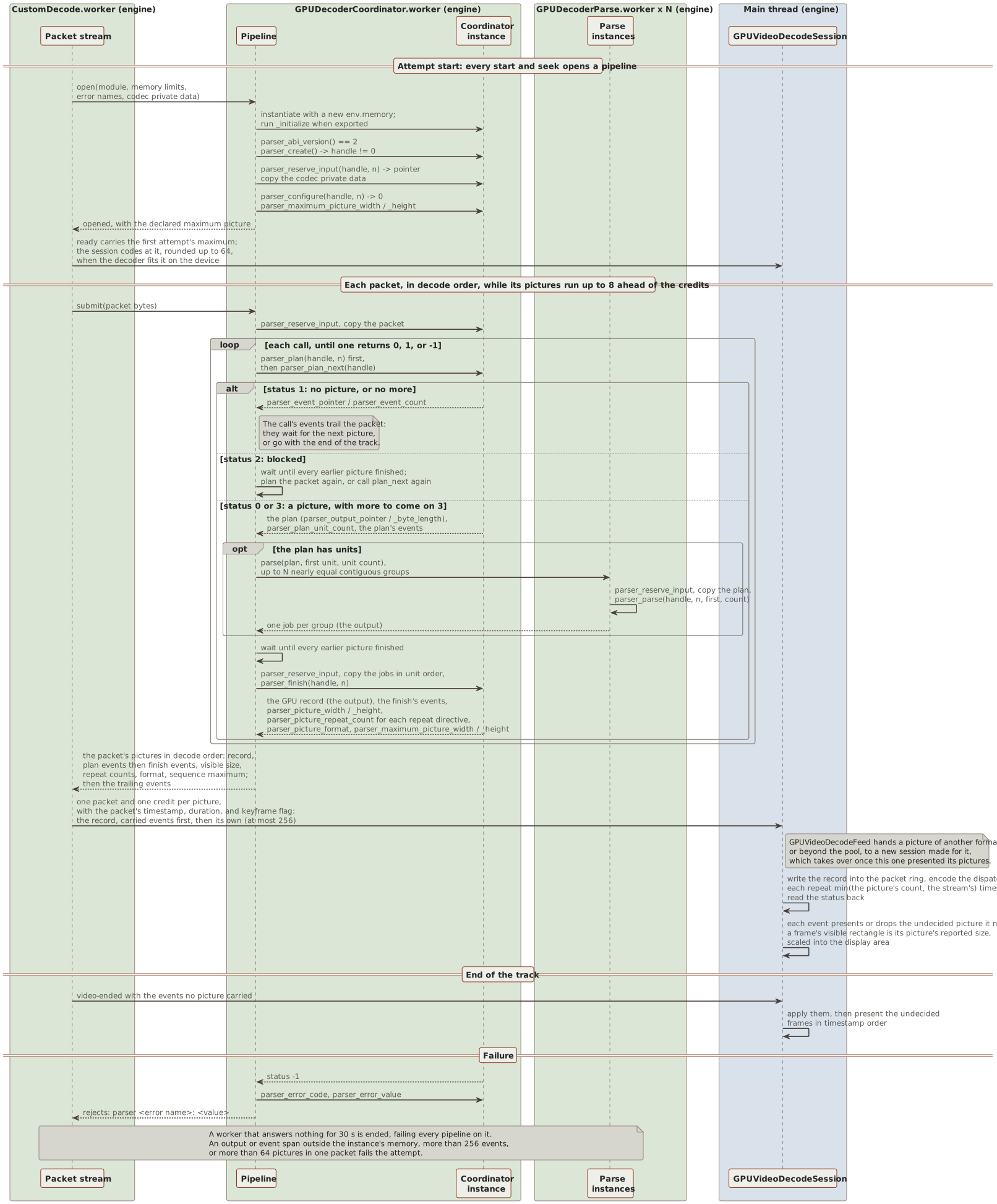
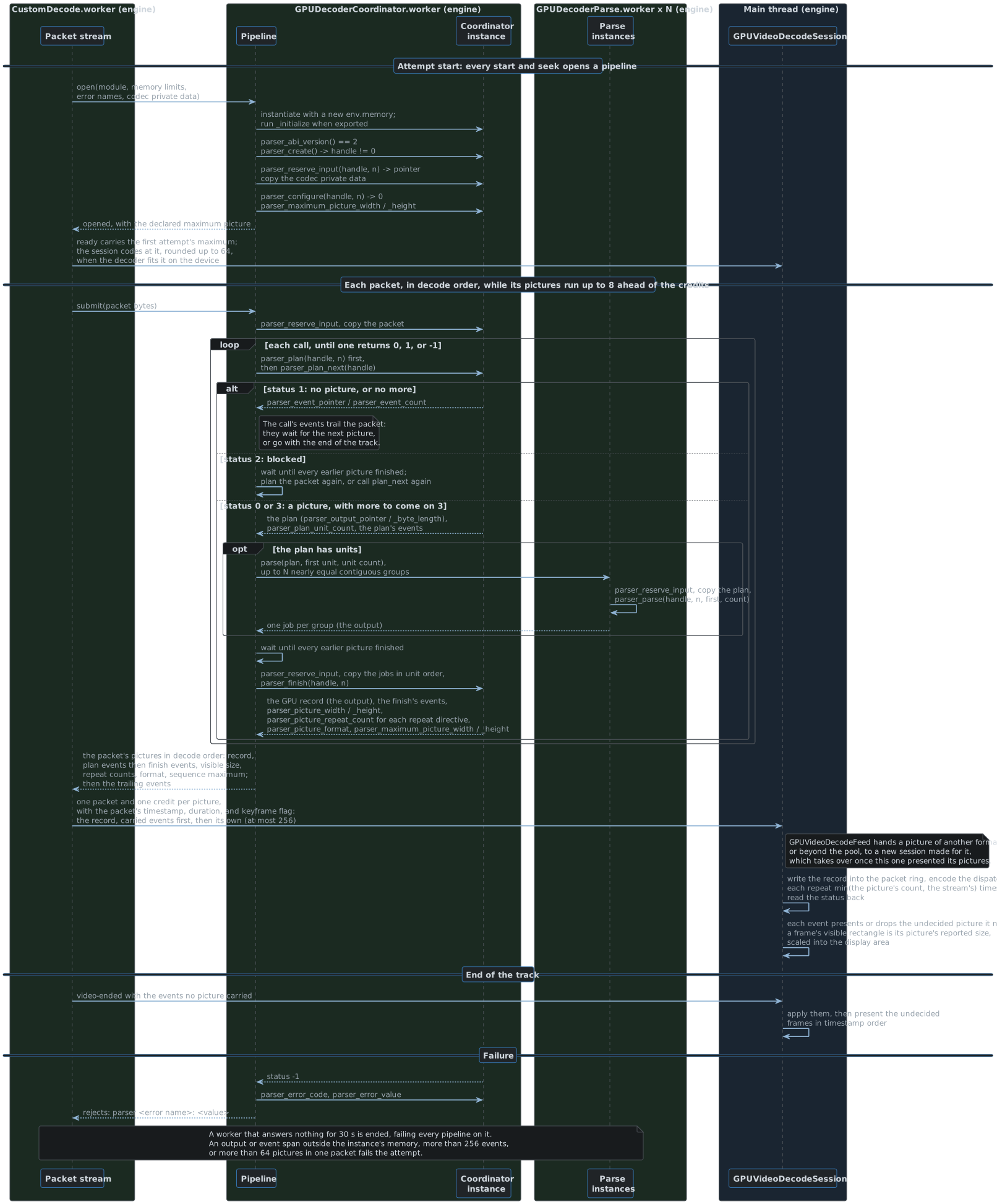
Every export but the first two takes the handle parser_create returned; pointers, lengths, and counts are u32, and statuses i32.
| Export | Returns | Does |
|---|---|---|
parser_abi_version() | 2 | The interface version, which the engine checks |
parser_create() | A handle, not 0 | Creates an instance’s state |
parser_destroy(handle) | Frees it | |
parser_reserve_input(handle, byteLength) | A pointer, not 0 unless the length is 0 | A buffer the next call reads its input from |
parser_configure(handle, byteLength) | Status | Reads the codec private data in the input |
parser_maximum_picture_width(handle), parser_maximum_picture_height(handle) | A size | Read right after a successful configure, the largest picture the codec private data declares, such as an AV1 sequence header’s maximum frame size, and right after each picture, the largest picture of its sequence; 0 and 0 for none |
parser_reset(handle) | Drops every picture and parameter set; configure must run again | |
parser_plan(handle, byteLength) | Status | Plans the first picture of the packet in the input, in decode order; its output is the picture’s plan |
parser_plan_next(handle) | Status | Plans the packet’s next picture after a plan or plan_next that returned 3; it reads no input, and its output is that picture’s plan |
parser_plan_unit_count(handle) | A count | The last plan’s units, which parse calls may split |
parser_parse(handle, byteLength, firstUnit, unitCount) | Status | Parses units of the plan in the input; its output is a job |
parser_finish(handle, byteLength) | Status | Finishes the oldest planned picture from its jobs in the input, concatenated in unit order; its output is the picture’s GPU record |
parser_picture_width(handle), parser_picture_height(handle) | A size | Read right after a finish, decode, or decode_next that output a picture: its visible size, or 0 and 0 for none |
parser_picture_format(handle) | A format | Read right after the same calls: the output format the picture decodes into, its chroma format as chroma_format_idc counts it, 0 for 4:0:0, which decodes into 4:2:0, shifted left 8, ORed with its bit depth, 8, 10, or 12; 0 for the session’s format |
parser_picture_repeat_count(handle, repeat) | A count | Read right after the same calls, once for each repeat: directive, repeat counting them from 0 in header order: how many times the picture’s record runs it |
parser_picture_fields(handle) | A picture fields word | Optional. Read right after the same calls: the picture’s fields as reportPictureFields stores them, bit 0 reported, bit 1 interlaced, bit 2 top field first, bit 3 a progressive picture’s repeat first field; 0 reports none |
parser_decode(handle, byteLength) | Status | Plans, parses, and finishes the first picture of the packet in the input on this instance |
parser_decode_next(handle) | Status | Plans, parses, and finishes the packet’s next picture on this instance; it reads no input |
parser_output_pointer(handle), parser_output_byte_length(handle) | The last call’s output | |
parser_event_pointer(handle), parser_event_count(handle) | The last call’s output events, as words | |
parser_error_code(handle), parser_error_value(handle) | The last failure’s code, one the header’s error: lines name, and its failing value |
| Status | Meaning |
|---|---|
| 0 | Success; from a plan, plan_next, decode, or decode_next, the call planned the packet’s last picture |
| 1 | No picture: from a plan or decode, the packet holds none; from a plan_next or decode_next, it holds no more. The call’s events still apply |
| 2 | Blocked, from a plan or plan_next: the call waits until every earlier picture finished, as a codec whose parsing reads earlier pictures needs. A blocked plan kept no state, and the engine plans the packet again; a blocked plan_next kept its place, and the engine calls plan_next again |
| 3 | A picture, and more of the packet’s pictures follow: the engine calls plan_next, or decode_next on one instance |
| -1 | A failure, with its code and value |
A failure’s code decides what follows: a code the header gives any recovery resyncs at the next key packet with a new parser, as Errors and recovery describes, and any other ends the attempt.
A parser that can go on past damage, as FFmpeg’s decoders conceal it, outputs the picture’s record with the damage marked and lets its WGSL conceal it and report a conceal code, rather than fail.
The engine calls plan_next after every 3 until a call returns 0, 1, or -1, and plans no later packet before; a packet holds at most 64 pictures.
A plan without units parses nothing, so its finish receives no jobs.
parser_decode and parser_decode_next run a packet on one instance, as a decoder project’s tests do; every earlier picture finished there, so a blocked decode fails.
A picture’s visible size is its top-left width x height samples, which must lie within the pool’s coded size, or the session fails as visible-rectangle; a report that gives one side without the other fails the attempt.
Presentation scales each frame’s own visible rectangle into the stream’s display area, so a stream whose frame size changes, as AV1’s may, plays at one size; a picture without a report keeps the stream’s visible rectangle.
A repeat count above the directive’s count for the stream runs the directive’s count, so a parser without a smaller one returns 4294967295, and 0 skips the run.
The largest picture the codec private data declares sizes the session, as How a session decodes describes; the decode worker opens its first attempt’s parser before the track is ready, so the ready response carries it.
A picture’s format and its sequence’s largest picture decide whether it needs a session of its own, as Stream changes describes; a format no output format holds, such as 4:2:0 at 9 bits, fails the attempt as parser picture format 0x109.
A picture’s fields word travels with its record to the frame, which the deinterlacing pass reads (see Architecture); a parser without parser_picture_fields reports none, so its frames keep their container’s fields, and a word that sets a bit beyond the four, or any without bit 0, fails the attempt as parser picture fields 0x12.
The engine copies each output and event list out of the instance’s memory before its next call on that instance, and fails the attempt when a pointer and length leave the memory.
The engine runs a parser on these instances, each with its own memory:
- A coordinator instance on the decode worker’s coordinator worker,
webgpu-player/GPUDecoderCoordinator.worker.js, which configures, plans each packet’s pictures as the packet arrives, and finishes pictures one at a time in decode order. Every start and seek opens a new coordinator instance. - One instance on each parse worker,
webgpu-player/GPUDecoderParse.worker.js: one worker per core beyond two, from one to six. A picture’s units split into at most that many nearly equal, contiguous groups, which parse in parallel, and each parse call receives the serialized plan. The coordinator worker keeps its parse workers for later attempts while the package’s id and content hash stay the same. - The decode worker reads packets until their pictures run eight ahead of its credits, a packet still parsing counting as one, so the workers stay busy while the page decodes.
- A worker that answers nothing for 30 seconds is ended, and every pipeline on it fails.
Each picture reaches the page as a packet of its own: its record with its packet’s timestamp, duration, and keyframe flag, its own run of the dispatch sequence into its own output slot, and one video credit.
Only the first picture after a start or a seek carries reset, and the first picture of a packet carries the packet’s HDR10+ state.
An output event is a u32 word: bits 0 to 29 hold a picture’s index, counted from 0 in decode order since the instance started, modulo 2^30, every picture of a packet counting.
Bit 31 drops the picture instead of presenting it, as for a picture its stream marks not for output or an AV1 temporal unit’s hidden frame, and bit 30 is reserved and must be zero.
A picture’s plan or plan_next events and then its finish’s travel with its record; the events of a call that planned no picture wait for the next picture, or for the end of the track.
The session holds each decoded frame until an event names it, and a picture an event drops frees its slot at once.
An event for a picture that already left changes nothing, and an event for a picture not yet decoded fails the attempt as output-event.
When more frames wait undecided than the header’s reorder, the earliest presents, so the pool never fills.
At the end of a track the waiting events apply first, then the frames still undecided present in timestamp order.
A picture’s record carries at most 256 events, its own and those carried to it.
Self-test vectors
A video package may carry known-answer vectors of its own in its webgpu-player.vectors section, at most one per output format.
The engine runs one only when a host calls verifyGPUDecoderPackage(device, package, format) in src/decode/video/gpu/GPUDecoderVerification.ts; playback never runs them, and nothing caches the result.
getGPUDecoderVectorFormats(package) lists the formats a package carries vectors for.
A check decodes the vector’s packets in a session on the device, through the parser when the package has one, reads back frames firstFrame to lastFrame in presentation order, and compares their SHA-256 with the vector’s.
The hash covers each checked frame’s luma plane, then its two chroma planes, cropped to its visible rectangle, rows tightly packed and 16-bit samples little-endian: FFmpeg’s rawvideo output of those frames in the vector’s format, such as yuv422p10le.
A frame’s visible rectangle is the visible size its picture reported, at the top left, or the vector’s, so a vector whose frame size changes checks each frame at its own size.
A check returns passed with the hash, unverified when the package carries no vector for the format, or the check that failed: parser-failed, decoder-recovered with the first recovery, such as decoder-recovered: concealed coefficients: 90112, frames-dropped, frames-missing, slots-exhausted, hash-mismatch, or the session’s failure code.
The section is little-endian u32 words, names and data padded to whole words; src/decode/video/gpu/GPUDecoderVectorSet.ts reads and writes it.
| Part | Words |
|---|---|
Magic WPDV (0x56445057), version 2, vector count | 3 |
| Per vector: its byte length | 1 |
The format name’s length, then the name, such as I420P10 | 1 + name |
| The visible width and height, which the stream facts derive from | 2 |
| The first and last checked frame | 2 |
| The SHA-256 of the checked frames | 8 |
| The codec private data’s length, then the data | 1 + data |
| The packet count, then each packet: its length, flags (bit 0 keyframe), timestamp and duration in microseconds, then its data | 1 + packets |
Audio decoders
An audio decoder’s module decodes packets to planar float PCM, which the engine downmixes, resamples to 48 kHz, and plays like any decoded audio.
The header
An audio package’s decoder section is its manifest, a //! header like a video decoder’s; any text after the header is ignored.
src/decode/audio/AudioDecoderManifest.ts parses it.
| Directive | Required | Value |
|---|---|---|
id | Yes | The package’s id, as Identity describes |
name | Yes | Any text |
decoder | Yes | audio |
accepts | Yes | codec in [<codecs>], by the engine’s audio codec names, such as ac3, eac3, dts, mlp, truehd, wmav1, wmav2, wmapro, wmalossless, or wmavoice |
packet | No | The largest packet it takes, at most 16 MiB; 2 MiB by default |
attribute | Repeatable | <key>, <name>: a codec-specific value the module reports, key 1 to 255 |
option | Repeatable | <key>, <name>: a codec-specific setting a host may set, key 1 to 255 |
error | Repeatable | <code>, <name>: names an error code |
//! id: eac3
//! name: E-AC-3
//! decoder: audio
//! accepts: codec in [eac3, ac3]
//! packet: 2 MiB
//! attribute: 1, libraryVersion
//! error: 1, input
//! error: 2, send
Codec private data
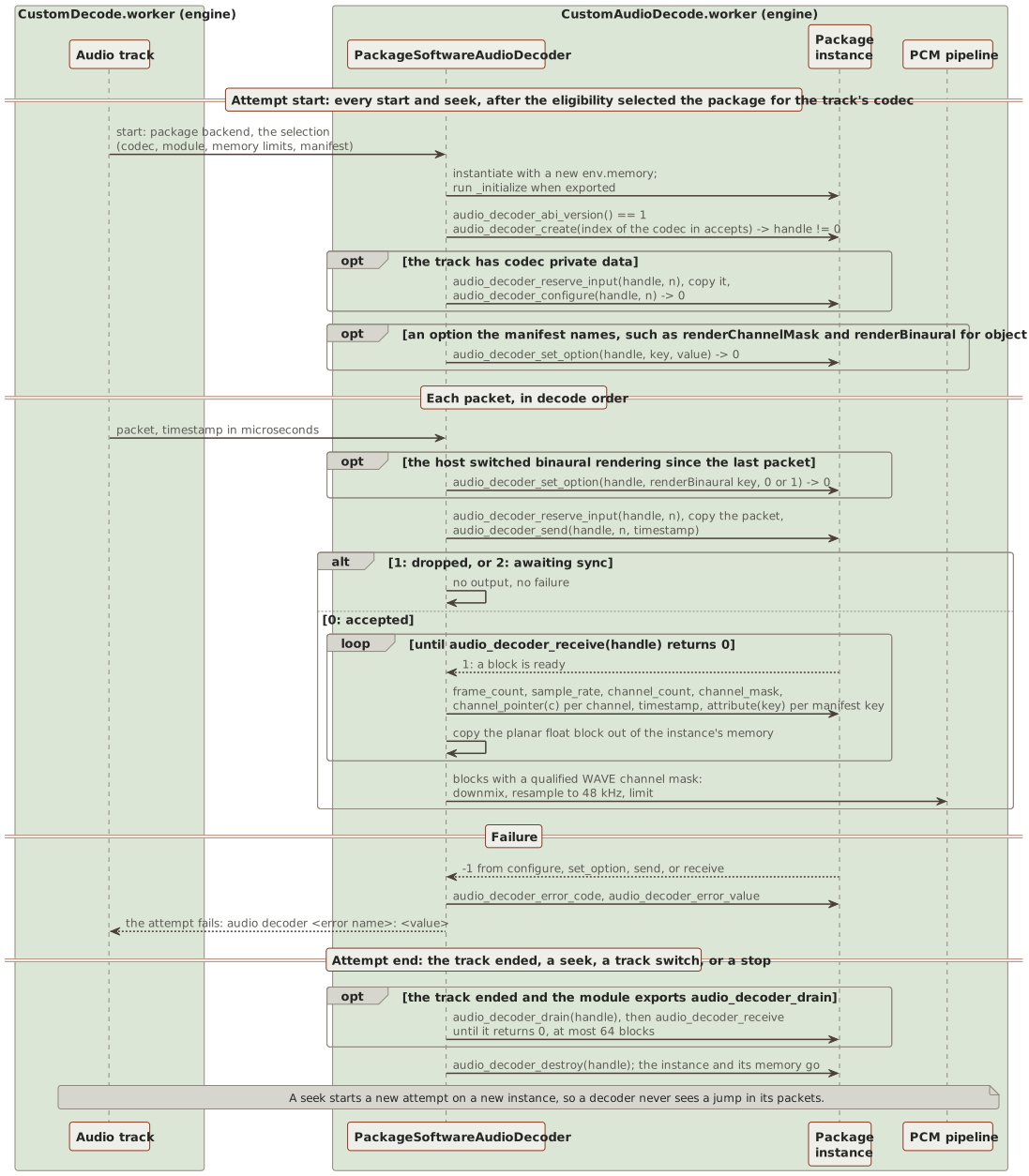
The decode worker reads a track’s codec private data for its codec, as FFmpeg’s demuxers hand it to their decoders, and sends it with the attempt’s package selection to the audio decode worker.
There PackageSoftwareAudioDecoder hands it to audio_decoder_configure once, before the attempt’s first packet; a track without any makes no configure call.
A configure call that fails ends the attempt with the package’s named error.
| Codec | audio_decoder_configure reads |
|---|---|
ac3, eac3, dts, mlp, truehd | Nothing; the decoder finds everything in its packets |
wmav1, wmav2, wmapro, wmalossless, wmavoice | The track’s WAVEFORMATEX: its 18-byte header (format tag, channels, rate, average bytes per second, block alignment, bits per sample, and cbSize, little-endian), then the cbSize bytes after it, the WAVE_FORMAT_EXTENSIBLE fields first when the tag is 0xFFFE; a Matroska A_MS/ACM track’s CodecPrivate up to the end of those bytes, whatever follows, or an AVI stream’s strf chunk, which the worker writes back from the fields the fork parsed |
The audio decoder interface
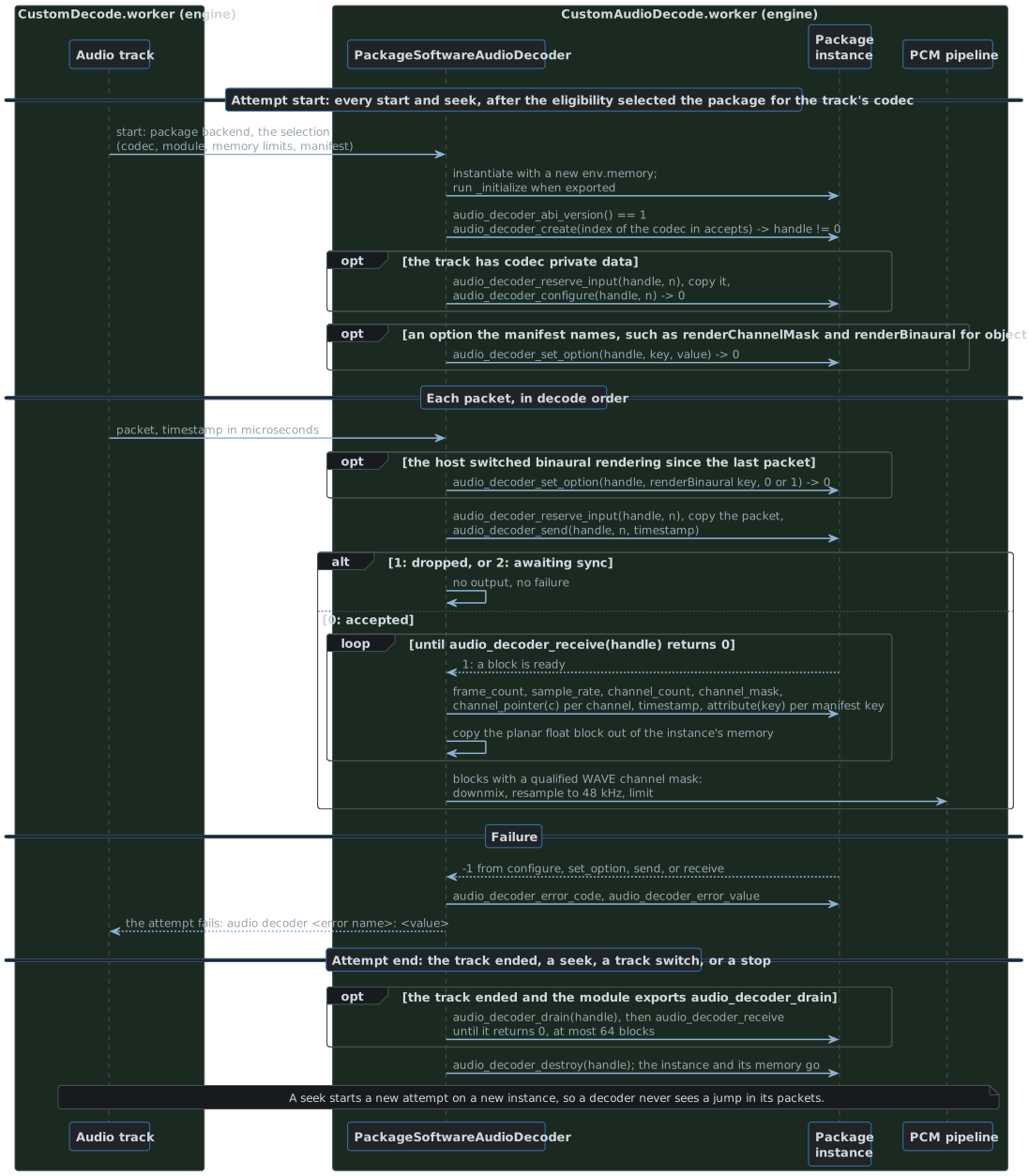
The module implements version 1 of this interface, which wgpud/include/audio_decoder_interface.h declares for C.
src/decode/audio/AudioDecoderPackageInstance.ts drives it, on the playback worker’s audio decode worker.
| Export | Returns | Does |
|---|---|---|
uint32_t audio_decoder_abi_version(void) | 1 | The interface version, which the engine checks |
handle audio_decoder_create(int codec) | A handle, not 0 | Creates a decoder of the codec at that position of accepts |
void audio_decoder_destroy(handle) | Frees it | |
uint8_t *audio_decoder_reserve_input(handle, uint32_t byte_length) | A pointer, not 0 | A buffer the next call reads its input from |
int audio_decoder_configure(handle, uint32_t byte_length) | 0 or -1 | Reads the track’s codec private data in the input |
int audio_decoder_set_option(handle, uint32_t key, double value) | 0 or -1 | Sets an option the manifest names |
int audio_decoder_send(handle, uint32_t byte_length, double timestamp) | 0, 1, 2, or -1 | Sends the packet in the input, with its timestamp in microseconds |
int audio_decoder_receive(handle) | 1, 0, or -1 | 1 when a block is ready, 0 when the packet has none left |
uint32_t audio_decoder_frame_count(handle) | The block’s frames, 1 to 65536 | |
uint32_t audio_decoder_sample_rate(handle) | The block’s sample rate | |
uint32_t audio_decoder_channel_count(handle) | The block’s channels, 1 to 32 | |
uint32_t audio_decoder_channel_mask(handle) | The block’s layout as a WAVE channel mask | |
float *audio_decoder_channel_pointer(handle, uint32_t channel) | A channel’s samples, 4-byte aligned | |
double audio_decoder_timestamp(handle) | The block’s timestamp in microseconds, or -1 to continue from its packet’s | |
double audio_decoder_attribute(handle, uint32_t key) | An attribute the manifest names, or NaN when it has none | |
void audio_decoder_clear(handle) | Drops the state between frames | |
uint32_t audio_decoder_error_code(handle), uint32_t audio_decoder_error_value(handle) | The last failure’s code, one the manifest’s error: lines name, and its failing value |
audio_decoder_send returns 0 when it accepted the packet, 1 when it dropped it, 2 while it waits for a sync point, or -1 when it failed.
A dropped packet, and one before a sync point, decode to nothing and fail nothing.
After an accepted packet the engine calls audio_decoder_receive until it returns 0, and copies each block out of the instance’s memory: its channels’ planar floats, its layout, its timestamp, and every attribute the manifest names.
A packet’s blocks number at most its byte length, and their frames at most 65536 per byte.
A block’s channel mask must be one the engine mixes: mono, stereo, 3.0, 2.1, 3.0 with a back center, 5.1 with back or side speakers, 6.1, 7.1, or one of FFmpeg’s height layouts, 5.1.2 (0x503F), 5.1.4 (0x2D03F), 7.1.2 (0x563F), and 7.1.4 (0x2D63F), or 5.1 with side speakers and the top front pair (0x560F), which FFmpeg’s E-AC-3 decoder reports for a dependent stream with heights.
A height layout’s channels follow its mask bits too: the floor’s, then top front left and right, then top back left and right.
An E-AC-3 or TrueHD package’s block may have a height mask whatever channel count the track declares; any other package’s blocks must fit its codec’s input routes (see Audio routes).
Every start and seek is a new attempt on a new instance, which audio_decoder_destroy ends, so a decoder never sees a jump in its packets.
A module may also export int audio_decoder_drain(handle), which returns 0 or -1.
The engine calls it once at the end of a track, after the attempt’s last packet, then calls audio_decoder_receive until it returns 0, so a decoder that holds frames back, as FFmpeg’s do, outputs them; at most 64 blocks follow.
A drained block without a timestamp of its own continues from where the last block ended, or, when no block came before it, as after a seek onto a track’s last packet, starts at the last packet’s time.
A module without the export ends the track at its last packet’s blocks, and findMissingAudioDecoderExports never asks for it.
Object audio
A package that renders object audio, such as Dolby Atmos in E-AC-3 and TrueHD, declares two options and one attribute by these names; their keys are its own.
| Name | Directive | Value |
|---|---|---|
renderChannelMask | option | The WAVE channel mask of the playback’s output layout: stereo 0x3, 5.1 0x60F, 7.1 0x63F, 5.1.2 0x503F, 5.1.4 0x2D03F, 7.1.2 0x563F, or 7.1.4 0x2D63F |
renderBinaural | option | 1 when the output is stereo and the host asked for binaural headphone rendering, else 0 |
objectCount | attribute | Per block: the dynamic objects the block renders, 0 for a stock decode |
The audio decode worker sets both options with audio_decoder_set_option after audio_decoder_configure and before the attempt’s first packet (PackageSoftwareAudioDecoder.setRenderTarget), and sets renderBinaural again between two packets when the host switches binaural rendering live.
A live change of the output layout starts a new attempt on a new instance, which takes the new mask before its first packet.
A package that declares neither option is never asked, and one that declares only renderChannelMask gets no renderBinaural.
The package renders object audio into exactly the mask’s layout, or into binaural stereo (0x3) with renderBinaural 1, and reports its blocks with that mask.
Where the target adds nothing to what its stock decode outputs, the package outputs the stock decode with its own mask instead, and a stream without objects always does; the engine plays either, folding or mixing it to the output layout by channel name.
The worker reports each change of the blocks’ objectCount to the page, whose decode telemetry shows it as decodedAudioObjectCount; a count above 1024 fails the attempt.
A block with objects passes through the output stage’s peak limiter, since the package sums them unlimited.
Hosts
Loading and keeping packages
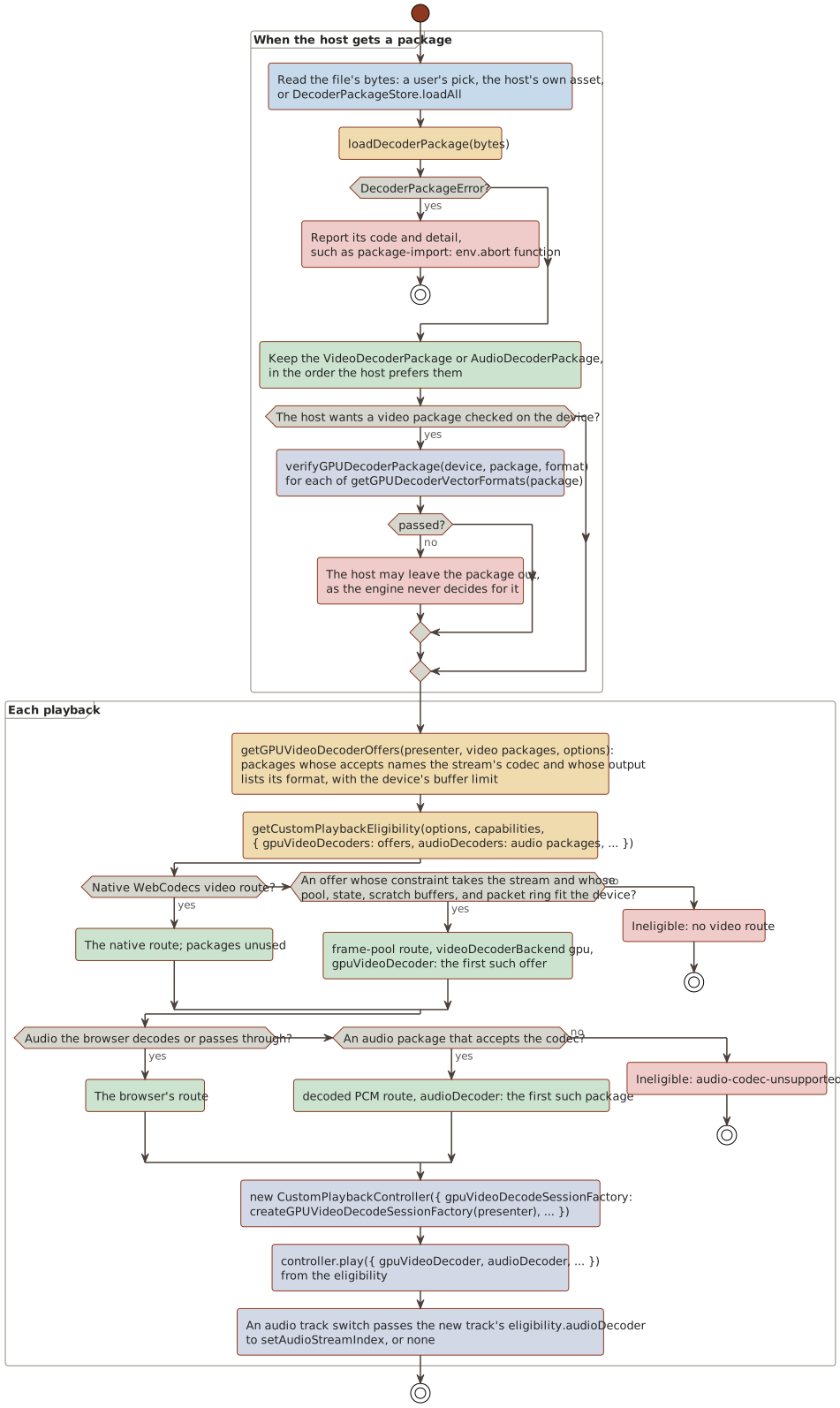
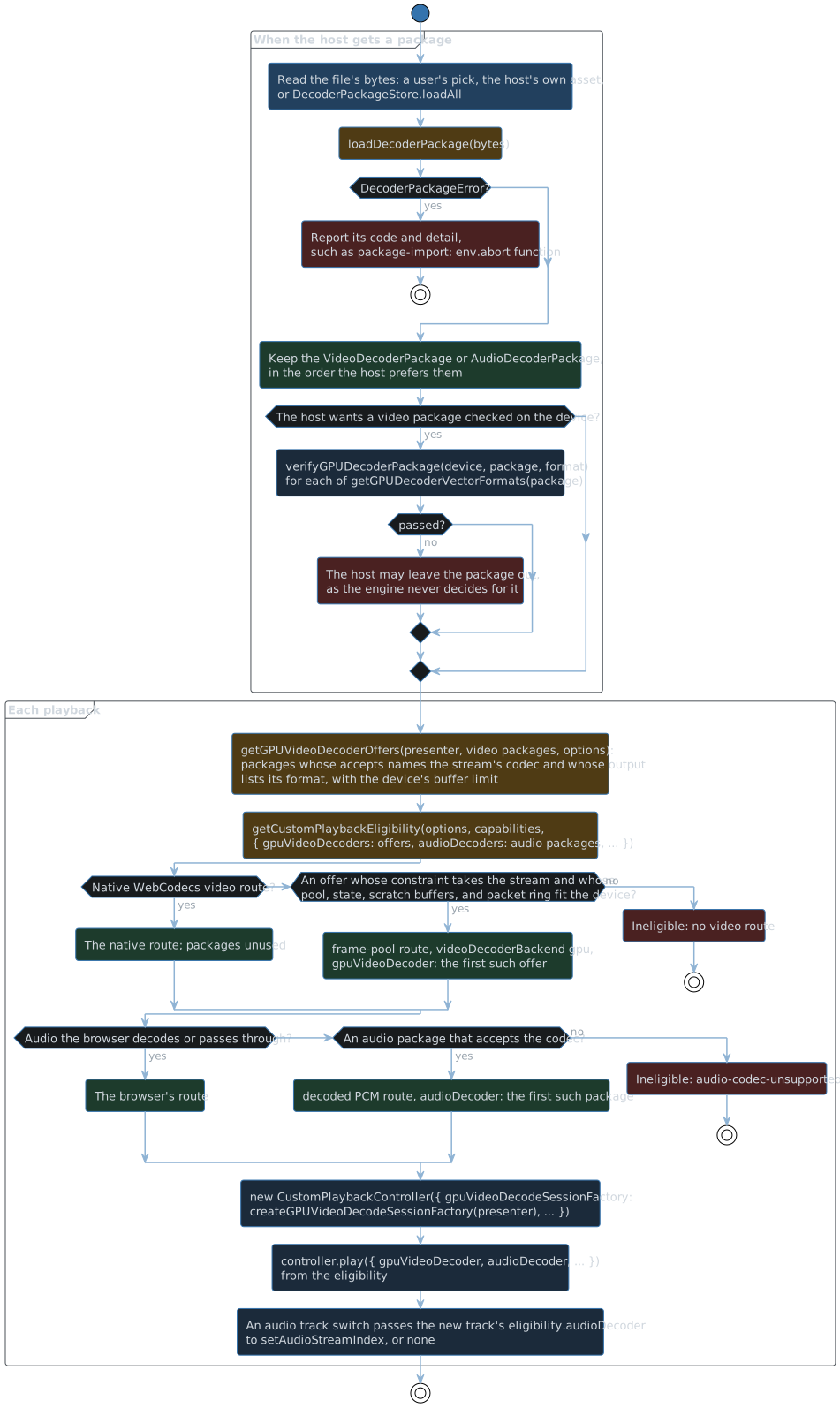
loadDecoderPackage(bytes)returns aVideoDecoderPackageor anAudioDecoderPackage: its id, content hash, name, manifest, compiled module, memory limits, and, for video, its vectors section. The compiled module crosses to the engine’s workers, which instantiate it with memory of their own.DecoderPackageStoreinsrc/decode/packages/DecoderPackageStore.tskeeps package files in IndexedDB by package id, under a database name the host chooses.add(fileName, bytes)loads a file with the engine’s checks before it stores it,remove(id)deletes one, andloadAll()loads every stored file, oldest first, with a failure for each one that no longer loads.load(id)loads the one stored file of an id, or null when the store holds none, so a host that caches packages it fetches compiles only the ones a playback needs. A file of an id the store holds is a new version of that package: it replaces the stored file and keeps its place in the order. The store’s schema is version 2, which keys files by id; a database of an earlier version opens empty, without its files.- Where a host gets package files is its own choice: the engine fetches none.
The decoder projects in the decoders repository, checked out at the engine’s
wgpud/, build packages a host may offer, and that repository’s releases publish them (see WebAssembly build).
Offering packages to a playback
getGPUVideoDecoderOffers(presenter, videoPackages, options)insrc/presentation/PresentationSetup.tsreturns the packages whoseacceptsnames the stream’s codec and whoseoutputlists its format, in the host’s order, with the device’s buffer limit, the smaller of its largest buffer and its largest storage binding. The host passes them as the eligibility’sgpuVideoDecoders.- The host passes its audio packages, in its order, as the eligibility’s
audioDecoders. With them it passesaudioRenderTarget, the speaker layout it chose for the destination and its binaural headphone setting, so that a Dolby Atmos stream whose objects the target needs takes a package that declaresrenderChannelMaskahead of the browser’s own decoder (see Audio routes). The eligibility then setsaudioRendersObjects, and the host plays the track to the whole speaker layout. - A host that fetches packages only when a playback needs them asks first what the playback decodes:
getGPUVideoDecodeTarget(options)insrc/capability/CustomPlaybackEligibility.tsnames the video’s codec and frame pool format, andgetPlaybackAudioCodec(options)the codec of the audio track the eligibility selects. - Before a playback, a host passes what its video packages decode as
hasEligibleCustomVideoRoute‘sgpuVideoDecoderSummaries: their codecs and output formats, and where it has them, each package’s header and the device’s buffer limit, so the summary runs the offers’ fit check; see GPU decoders.parseGPUDecoderHeaderinsrc/decode/video/gpu/GPUDecoderManifest.tsreads a header without its body, such as a server’s catalog carries, with every check of the manifest parser but the body’s. - The eligibility prefers a native WebCodecs video route; otherwise it takes the first offer whose
acceptsconditions take the stream and whose pool,state,buffer:s, and packet ring each fit the buffer limit, on theframe-poolroute with thegpudecoder backend.findGPUDecoderStreamFitFailureinsrc/decode/video/gpu/GPUDecoderStreamFit.tschecks them at the container’s size. An HDR stream takes a package only when the host tone-maps frame-pool HDR, theallowFramePoolHDRpresentation option. - For audio it prefers passing the track through to the browser, then the browser’s own decoder, then the first package whose
acceptsnames the track’s codec, on the decoded PCM route. - The output format of a stream is its HEVC range extension format when it has one, otherwise the format that holds its pixel format, such as I422 for
yuv422p, or 4:2:0 at its bit depth when the stream names no pixel format. A 4:0:0 pixel format,gray,gray9,gray10, orgray12in either byte order, takes the 4:2:0 format of its depth, and only a decoder whose header declaresmonochromeis offered it. A JPEG 2000 stream inxyz12letakes I444P12, which a JPEG 2000 decoder writes as limited-range BT.709 Y’CbCr of FFmpeg’s conversion of its X’Y’Z’ to R’G’B’. - The controller takes
gpuVideoDecodeSessionFactory: createGPUVideoDecodeSessionFactory(presenter, { slicing }), whereslicingis the host’s choice of sliced decode submits, andplay()takes the eligibility’sgpuVideoDecoderandaudioDecoder. - The host calls
precompilePredictedGPUVideoDecoder(presenter, offers, options)without waiting as its negotiation starts, andprecompileGPUVideoDecoder(presenter, eligibility)without waiting before the rest of its setup, so the decoder compiles while the negotiation, the presentation, the controller, and the worker’s open of the file proceed. - A host may call
warmGPUVideoDecoders(presenter, videoPackages)after its background probe warm-up with the packages it already holds; it downloads nothing. - An audio track switch passes the new track’s
audioDecoderfrom its own eligibility tosetAudioStreamIndex, with itsaudioMetadataLayout(getAudioMetadataLayout); the previous track’s package and layout never carry over.
Verifying a package
Verification is the host’s choice and never the engine’s.
A host that wants a package checked on the user’s device calls verifyGPUDecoderPackage for each format getGPUDecoderVectorFormats lists, before it offers the package, and decides what a failure means.
Each call decodes again, so a host that keeps results keys them itself, by the package’s id and content hash and the device, since a new version of the id needs its own.
Failures
Every failure carries a code and a terse detail with the failing value.
- Loading: the
DecoderPackageErrorcodes above, such aspackage-manifest: id-syntax: 'AV1' (line 1). - A video session: its failure code, such as
compile-errorwith the body’s line,dispatch-count,decoder-errorwith the name and value of an error without a recovery,output-event,packet-size: ring 1073741824 > 268435456, orvisible-rectangle: picture 1920x1088 exceeds 1280x768, which ends the route’s attempt as any failed route does. - A recovery is no failure: its code and detail, such as
concealed coefficients: 90112orresynced parser sliceHeader: 3, count in the feed’s telemetry, and the playback goes on. - A stream change:
accepts: picture 4096x2160 in pool 4096x2176 at 8 bitswhen the decoder takes no pool for the picture, or the new session’s creation failure, such asformat-unsupported: I444P12 not in I420, I420P10, which ends the attempt as the first session’s would. - A parser:
parser <error name>: <value>, or the step that failed, such asparser reserve_input refused 4096 bytes,parser events 300 > 256,parser pictures 65 > 64 in one packet,parser plan_next status 7,parser picture format 0x109, orparser maximum picture size 1920x0. - An audio decoder:
audio decoder <error name>: <value>, which ends the audio attempt.